
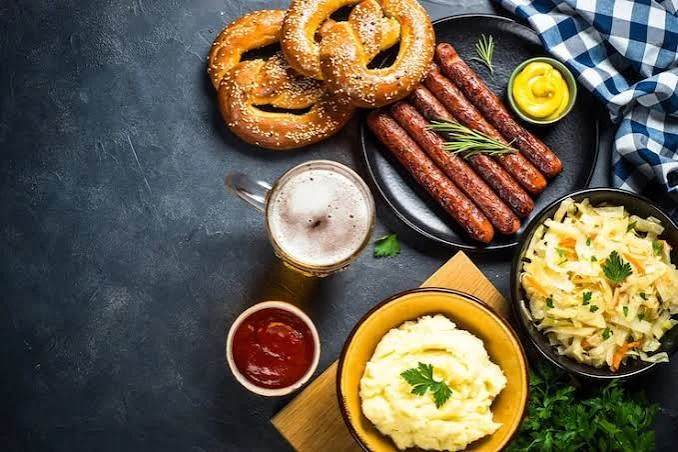
German food suffers from a reputation problem. Outside the country, many people reduce it to a short list: sausages, sauerkraut, pretzels, and beer. This picture is not wrong, but it is terribly incomplete. The truth is that Germany has one of the most varied and historically rich food cultures in Europe. Its dishes reflect centuries of political change, regional isolation, agricultural reality, and a deep respect for ingredients that were available close to home.
This article is not a quick list of dishes to try. It is a careful look at the traditional foods that Germans actually eat, why they eat them, and what those dishes reveal about the country. You will find no complicated cooking terms and no filler. What follows is a thorough guide to the heart of traditional german cuisine dishes.
Why German Food Is More Than Sausage and Beer?
The most common mistake people make about German cuisine is treating it as one single thing. In reality, Germany was not unified as a modern nation until 1871. Before that, it was a collection of kingdoms, duchies, and free cities. Each region had its own climate, its own soil, its own neighbors, and its own food traditions. Even today, a person from Bavaria in the south eats very differently from someone on the North Sea coast.
The north has cold waters and long coastlines, so fish plays a central role. The south has mountains, dairy farms, and a border with Austria and Switzerland, which explains the heavy use of cheese, noodles, and rich sauces. The west, near France, shows French influence in dishes like Flammkuchen. The east, near Poland and Russia, has soups and stews that reflect those connections.
This regional variety is not a minor detail. It is the single most important fact about German food. Any honest discussion of traditional German cuisine must start there.
Read Also: Traditional Southern Food Dishes
The Foundation: Bread, Potatoes, and Pork
Before looking at specific dishes, it helps to understand three ingredients that appear again and again on German tables.
Bread as a Daily Anchor
Germans take bread seriously. The country produces more than 300 different types of bread, and bakeries are treated as essential parts of daily life. The most common breads are made from rye or a mix of rye and wheat, which gives them a dark color and a dense, slightly sour taste. This is not the soft, sweet bread found in many supermarkets elsewhere. German bread is meant to be chewed slowly and to carry strong flavors.
A typical German breakfast, called Frühstück, centers on bread with butter, jam, honey, cheese, or cold cuts. The evening meal, Abendbrot, which literally means "evening bread," is often a cold spread of bread, cheese, sausage, and pickles. This pattern has held steady for generations, and recent studies show that nearly 78 percent of German households still eat this kind of cold evening meal at least once a week.
The Potato's Long Journey
The potato arrived in Germany from South America in the 18th century. At first, people viewed it with suspicion. It was seen as food for animals, not for humans. King Frederick II of Prussia pushed hard to change that view, and over time the potato became a cornerstone of German cooking.
Today, potatoes appear in dozens of forms. They are boiled, mashed, fried, turned into dumplings called Knödel, and made into pancakes called Kartoffelpuffer. In some regions, they are the main part of a meal, not just a side dish. The potato's rise from animal feed to national staple is one of the most interesting stories in German food history.
Pork and the Art of Preservation
Pork is the most consumed meat in Germany. Every part of the pig is used, not just the best cuts. This comes from a practical past when meat was expensive and nothing could be wasted. Pork knuckle, called Schweinshaxe, is a good example. It is a tough cut that becomes tender only after hours of slow cooking.
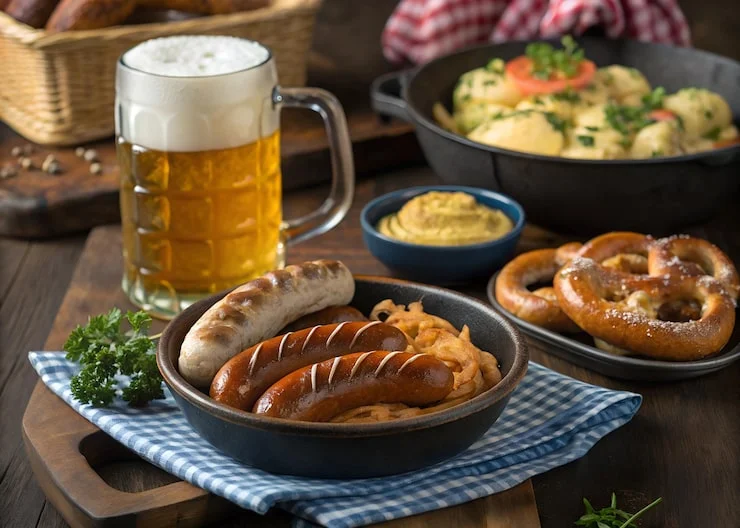
Sausage became the main way to preserve pork for the cold months when fresh meat was not available. Germany is said to have at least 1,500 different kinds of sausage, each with its own mix of meat, herbs, grains, and spices. Some are eaten cold, some are fried, some are poached, and some go into soups and stews. Bratwurst is the most famous, but it is only one small part of a much larger picture.
Dishes from the North: Fish, Cabbage, and the Sea
The northern coast of Germany faces the cold waters of the North Sea and the Baltic. Fish is not a specialty here. It is a daily reality.
Herring is the most important fish in this region. It is pickled, smoked, fried, and served in many ways. A popular street food is Fischbrötchen, a simple bread roll filled with pickled or smoked fish. It is cheap, fresh, and meant to be eaten while walking along the harbor.
Further inland but still in the north, kale becomes the star of winter meals. Around Bremen, Hanover, and Oldenburg, groups of friends and coworkers go on "kale tours" in the cold months. They walk through the countryside and then stop at a country inn for a heavy meal of kale cooked with lard, onions, and smoked sausage called Grützwurst. The kale is cooked for up to 90 minutes, which turns it soft and rich. This tradition is not fancy. It is about warmth, company, and surviving the dark winter together.
A dish that shows the northern character well is Labskaus. It began as food for sailors. The original version mixed salted meat, potatoes, and onions into a pink mash. It is often served with a fried egg, a pickled gherkin, and a piece of herring on the side. To someone unfamiliar, it looks unusual. To a northerner, it tastes like home.
The South: Dumplings, Noodles, and Mountain Cheese
Southern Germany, especially Bavaria and Swabia, has a food culture that many outsiders recognize as "typically German." This is the land of beer gardens, pretzels, and white sausage. But it is also the land of hand-made noodles and cheese dishes that deserve more attention.
Maultaschen are a good place to start. These are large, rectangular pockets of dough filled with sausage meat, spinach, onions, and soaked bread. They look a little like Italian ravioli, and people have argued for centuries about where the idea came from. The Swabians insist it is theirs, and since 2009, "Swabian Maultaschen" has had protected status in the European Union. They are usually served in a clear broth or sliced and fried with eggs. The filling is savory and satisfying, and the dish shows how southern cooks turned simple ingredients into something that feels generous.
Spätzle are another southern staple. These are small, irregular egg noodles made by scraping wet dough into boiling water. They are soft, slightly chewy, and perfect for soaking up gravy. In the Allgäu region, Spätzle are combined with mountain cheese and fried onions to make Kässpatzen, a dish that is essentially the German answer to macaroni and cheese, but with a sharper, more mature flavor.
Then there is Weisswurst, the white sausage of Munich. It is made from veal and parsley, poached rather than grilled, and served with sweet mustard and a wheat beer. There is a traditional rule that Weisswurst should not be eaten after noon, though many people treat this rule more as a joke than a law. The sausage is peeled from its skin at the table, which takes a little practice. It is a morning food, meant to be eaten slowly with good conversation.
The Heartland: Sauerbraten and the Sunday Roast
Moving into the central and western parts of Germany, one dish stands out as the definition of traditional German cooking: Sauerbraten.
Sauerbraten is a pot roast made from beef that has been marinated for several days in vinegar, water or wine, onions, and spices. The long soak gives the meat a tangy, slightly sour flavor that is unlike anything else in European cooking. After the marinade, the meat is cooked slowly for hours until it becomes tender. The sauce is often thickened with crushed gingerbread or a similar sweet element, which balances the sourness. This is not a quick meal. It requires planning and patience, and that is exactly the point.
Sauerbraten is tied to a larger tradition: the Sonntagsbraten, or Sunday roast. For much of German history, meat was expensive. Many families could only afford it once a week. Sunday, the one day of rest, became the day for a special meal. The roast was a reward for a week of hard work and a way to bring the family together. Today, with meat more available and daily schedules more crowded, this tradition has weakened. Some people predict it may disappear within a few decades. But in many rural areas and among older generations, the Sunday roast still matters.
A related dish from the Rhineland is Himmel und Erde, which means "Heaven and Earth." It combines blood sausage, which grows in the earth, with apples, which grow toward the sky, and mashed potatoes. The name is poetic, and the dish itself is a good example of how German cooking often mixes sweet and savory elements in ways that might surprise outsiders.
You May Also Like: Traditional Sikkim Momo Recipe At Home
The East: Stews, Soups, and Cold-Weather Comfort
Eastern Germany has its own food traditions, shaped by geography and by centuries of trade and migration from the east.
One dish that shows this clearly is Soljanka. It is a thick, spicy, and sour soup that originally came from Russia and Ukraine. It became popular in East Germany during the postwar period, and it remains a common menu item in Berlin and the surrounding region. It usually contains sausage, ham, pickles, cabbage, and tomatoes, and it is often served with a dollop of sour cream. The sourness comes from the pickles and sometimes from lemon. It is a warming, filling soup for cold days.
Leipziger Allerlei is another eastern classic. It was first written down in a Leipzig cookbook in 1745. The original recipe combined young peas, carrots, asparagus, and morels with crayfish, crayfish butter, and bread dumplings. The name has since been used for canned mixed vegetables, which is a shame, because the real dish is delicate and seasonal. It shows that traditional German cooking is not only heavy meat and potatoes. It can also be light, fresh, and carefully balanced.
Königsberger Klopse are meatballs from the former city of Königsberg, now Kaliningrad. They are made from ground veal or beef, poached in a broth, and served with a creamy sauce flavored with capers and lemon. The dish is a reminder that German food history includes places that are no longer part of Germany.
The Sweet Side: Cake, Coffee, and Christmas
German food is not only about dinner. The afternoon tradition of Kaffee und Kuchen, coffee and cake, is taken seriously in many households. Around three or four in the afternoon, people sit down with a cup of coffee and a slice of cake. Common choices include Käsekuchen, a quark-based cheesecake, or Apfelkuchen, a simple apple cake. This is a social ritual as much as a meal. It is a time to pause, talk, and enjoy something sweet.
At Christmas, the baking becomes more elaborate. Stollen is a dense bread filled with dried fruit, nuts, and spices, sometimes covered with a thick layer of powdered sugar. It was originally made without butter or milk because the Catholic Church did not allow those ingredients during Advent. After the 17th century, the rules changed, and butter became part of the recipe. Lebkuchen, a kind of gingerbread, is another Christmas staple. These sweets are not just food. They are markers of the season, tied to family memories and regional recipes passed down over generations.
How Germans Eat: The Daily Rhythm?
Understanding traditional German food also means understanding when and how it is eaten. The daily pattern has shifted over time, but some habits remain strong.
Breakfast is usually eaten at home and includes bread, cold cuts, cheese, boiled eggs, and coffee or juice. Lunch, Mittagessen, was traditionally the main hot meal of the day, served around noon or early afternoon. It typically includes meat or fish, potatoes or noodles, and a vegetable. Dinner, Abendbrot, is often cold: bread, cheese, sausage, and pickles. This pattern reflects a time when people worked close to home and came back for a midday meal.
Modern life has changed this for many people. Work schedules are longer, commutes are common, and lunch is often eaten away from home. Some families have reversed the pattern, eating a cold lunch and a hot dinner. But the idea of Abendbrot as a simple, cold meal remains strong. It is practical, quick, and rooted in the belief that dinner does not need to be complicated to be satisfying.
A Cuisine That Keeps Changing
One of the most important things to understand about German food is that it has never been frozen in time. It has always changed, borrowing from neighbors, adapting to hard times, and making the most of what was available.
The 19th century saw the rise of mass-produced food products like stock cubes and baking powder. The two World Wars brought rationing, hunger, and shortages. The postwar economic boom brought new wealth and new ingredients. Turkish and Italian immigrants who came to Germany in the 1960s and 1970s introduced new flavors that have since become part of everyday life. Döner kebab is now as common in Berlin as bratwurst.
Today, German chefs are reinterpreting old dishes with new techniques and lighter ingredients. Regional cuisine is experiencing a revival, with young cooks paying attention to local farms and seasonal produce. At the same time, traditional dishes like Sauerbraten and Maultaschen remain on menus, sometimes exactly as they were made a hundred years ago.
This flexibility is not a weakness. It is a strength. It shows that German cooking is a living thing, not a museum piece.
Conclusion
Traditional German cuisine is far richer than its international reputation suggests. It is a story of regions, not a single national style. It is a story of practical people making the most of what they had: pork preserved into sausage, potatoes turned into dozens of forms, fish from cold seas, and bread that traditional german cuisine dishes.
The dishes in this article are not just recipes. They are history on a plate. Sauerbraten carries the weight of a time when meat was precious. Labskaus remembers sailors and long voyages. Maultaschen speaks to the ingenuity of southern cooks. Kaffee und Kuchen honors the value of sitting down together.