
Okinawan traditional food dishes are unlike anything else you will find in Japan. The islands that make up Okinawa Prefecture sit far south of the main Japanese islands, closer to Taiwan than Tokyo. This distance shaped a food culture that developed its own rules, ingredients, and flavors over centuries. When you sit down to eat in Okinawa, you are tasting history. You are tasting a place that traded with China, Southeast Asia, and the Pacific long before it became part of Japan. You are tasting a cuisine built on pork, bitter vegetables, seaweed, and the idea that food should do more than fill your stomach. It should heal your body.
What Makes Okinawan Food Different?
Most people picture sushi, miso soup, and tempura when they think of Japanese food. Okinawan cuisine shares almost none of those things. There is no sushi tradition here. Miso soup is not the foundation of meals. Tempura is not a local specialty. Instead, Okinawan cooking grew from a different set of influences and a different set of needs.
The Ryukyu Kingdom ruled these islands for nearly five centuries, from 1429 until 1879 . During that time, Okinawa was a major trading hub. Ships from China, Korea, Southeast Asia, and the Pacific islands passed through. Each brought ingredients and cooking methods that local cooks absorbed and adapted. Chinese cooks taught Okinawan chefs how to braise pork. Southeast Asian traders brought bitter melon. The result is a cuisine that feels closer to some Southeast Asian cooking than to the Japanese mainland .
There is also the climate. Okinawa has a subtropical environment with hot, humid summers and mild winters. Food here needed to stand up to heat. Pickling, drying, and fermenting became important techniques. The vegetables that thrive in this climate, like bitter melon, sweet potatoes, and tropical fruits, became the backbone of the local diet.
Then there is the most famous aspect of Okinawan food: its connection to long life. For decades, Okinawa had the highest life expectancy in Japan and one of the highest in the world . Researchers studying the island's centenarians found that diet played a major role. The traditional Okinawan diet was low in calories but high in nutrients, rich in vegetables, soy, and seaweed, with moderate amounts of fish and pork . The local saying captures it well: "Food is medicine" (kusuimun in the Okinawan language).
Read Also: Traditional Sikkim Momo Recipe At Home
The Essential Okinawan Dishes You Need to Know
Goya Champuru: The Signature Stir-Fry
If you try only one Okinawan dish, make it goya champuru. This stir-fry is the most famous dish from the islands and appears on nearly every menu. The word champuru means "mixed" in the Okinawan language, and the dish lives up to the name.
The star ingredient is goya, also called bitter melon. It looks like a bumpy green cucumber and tastes intensely bitter. For first-time eaters, the bitterness is a shock. But Okinawan cooks know how to handle it. They slice the goya thin, rub it with salt, and squeeze out the liquid to reduce the bite. Then they stir-fry it with firm tofu, scrambled eggs, and thin slices of pork or Spam .
The combination works because the bitterness cuts through the richness of the egg and pork. It is a dish that feels healthy without feeling light. Goya is packed with vitamin C, and unlike many vegetables, its vitamin C does not break down much when heated . That makes this a genuinely nutritious dish, not just a tasty one.
Okinawa Soba: Not Your Typical Soba
The name is confusing. Okinawa soba contains no buckwheat, which is what soba usually means in Japan. These noodles are made from wheat flour and are thick, wavy, and slightly chewy, closer to udon than to Japanese soba .
The broth is where Okinawa soba shows its character. It is made from pork bones, bonito flakes, and kombu seaweed. The result is a rich, savory soup that tastes deep without being heavy. On top, you will find slabs of braised pork belly or pork ribs. The meat is cooked until it is soft enough to fall apart with a spoon. A few slices of pink pickled ginger and a fish cake round out the bowl .
Every island and every shop has its own version. Some serve thicker noodles. Some use a stronger broth. Some top the bowl with tofu or seaweed. Asking an Okinawan where to find the best soba is like asking an Italian where to find the best pasta. The answer will always be personal, and the debate never ends .
Rafute: The Royal Pork Belly
Rafute is Okinawan comfort food at its finest. This dish is made from thick squares of skin-on pork belly. The pork is slowly braised for hours in a mixture of soy sauce, brown sugar, mirin, and awamori, the local distilled spirit .
The result is meat that barely needs chewing. The fat turns soft and gelatinous. The skin becomes tender. The sauce is sweet, salty, and deeply savory all at once. A small piece of rafute served over white rice is a complete meal in itself.
This dish has royal roots. Long ago, rafute was reserved for the Ryukyu Kingdom's nobility. It was served at banquets and official events. The technique came from China, where a similar dish called dongpo rou is still made. Okinawan cooks adapted it with local ingredients, and it became a symbol of celebration and hospitality .
Jimami Dofu: Peanut Tofu
Tofu usually means soybean curd. Jimami dofu breaks that rule. This dish is made from peanuts, which are ground and mixed with sweet potato starch and water. The mixture is cooked until it thickens, then chilled until it sets .
The texture is smooth and slightly springy, like a firm pudding. The flavor is mild and nutty, with a natural sweetness that comes from the peanuts themselves. It is often served as an appetizer with a drizzle of soy sauce or a sweet sauce, depending on the region. In some places, it is eaten as a dessert. Either way, it is a dish that surprises people who expect tofu to taste like soy .
Umibudo: Sea Grapes
Umibudo looks like something from a science fiction movie. It is a type of seaweed made of tiny, translucent green spheres clustered on thin stems. Each little sphere is filled with liquid. When you bite into it, the sphere pops and releases a burst of briny seawater .
Okinawans call it "green caviar" for good reason. It is usually eaten raw with a simple dipping sauce made from ponzu or sesame dressing. The texture is the main event: crunchy, wet, and utterly unique. Umibudo is grown in the clean waters around Okinawa and is best eaten fresh. It does not freeze well, which means you have to go to Okinawa to experience it at its best .
Taco Rice: The American Connection
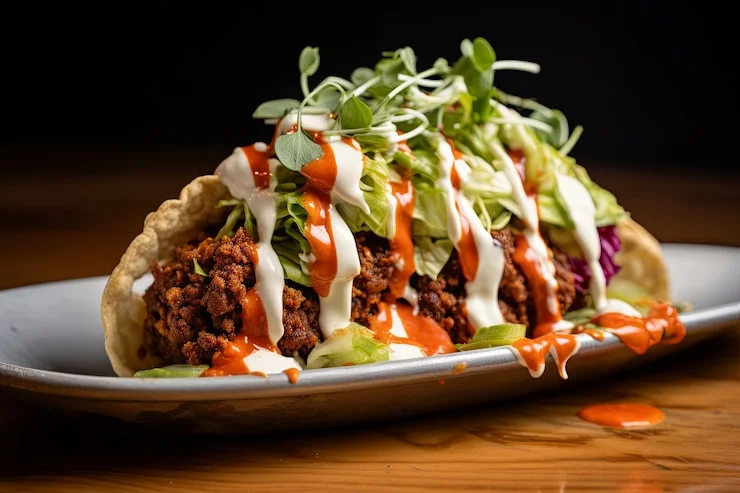
Not every Okinawan dish is centuries old. Taco rice was invented in the 1980s near a United States military base. The story goes that a local chef watched American sailors eating hard-shell tacos and decided to put the filling on top of rice instead. The result was taco rice: seasoned ground beef, shredded lettuce, diced tomatoes, and cheese piled on a bed of white rice .
It sounds simple, and it is. But it is also delicious in a way that has made it a staple across the island. Taco rice shows how Okinawan food culture keeps evolving. It absorbs new influences and makes them local.
The Ingredients That Define Okinawan Cooking
Pork: Every Part of the Pig
Okinawans eat more pork than any other region in Japan. The traditional saying is that they use every part of the pig except the squeal. Pork appears in almost every traditional dish, from the elegant rafute to the humble bowl of soba. The local breed, called Agu pork, is prized for its sweet fat and tender meat .
Pork bones form the base of many soups and broths. The ribs become soki, a classic soba topping. Pig's trotters are stewed until they are sticky and rich. Even pig's ear, called mimiga, is sliced thin and served as a crunchy snack, often dressed with vinegar .
Bitter Melon and Other Vegetables
Goya is the most famous Okinawan vegetable, but it is not the only one. The islands grow a wide range of greens, roots, and herbs that thrive in the subtropical climate. Sweet potatoes, especially the purple-fleshed beni-imo, were once the main source of calories for the population . Seaweed appears in many forms, from the delicate umibudo to the more substantial mozuku and konbu.
Awamori: The Local Spirit
Awamori is Okinawa's distilled liquor, and it is older than Japanese sake. It is made from rice, but unlike sake, it is distilled rather than brewed. The flavor is strong and slightly grassy. When aged for three years or more, it becomes kusu, or "old liquor," which is smoother and more mellow .
Awamori is not just for drinking. It is also used in cooking. A splash of awamori goes into the braising liquid for rafute. It adds a subtle fragrance that you cannot get from sake or wine. Sharing a bottle of awamori at an izakaya is a common way to end a meal in Okinawa.
You May Also Like: Traditional Bengali Recipes For Beginners At Home
How Okinawan Food Became a Longevity Diet?
The world became interested in Okinawan food because of the people who ate it. For much of the twentieth century, Okinawa had more centenarians per capita than almost anywhere else on Earth . Researchers wanted to know why.
The answer, they found, was not a single magic ingredient. It was the pattern of eating. The traditional Okinawan diet was plant-heavy and calorie-light. Sweet potatoes provided most of the energy. Vegetables, seaweed, and soy products made up a large part of every meal. Fish and pork appeared in smaller amounts. Meals were built around variety, not abundance .
This way of eating naturally created a low-calorie, nutrient-dense diet. People ate until they were about eighty percent full, a practice called hara hachi bu. The food itself was rich in antioxidants, vitamins, and minerals. It was low in saturated fat and high in fiber. Modern researchers have compared it to the Mediterranean diet and the DASH diet, finding many shared features .
It is important to note that this traditional diet has changed significantly since the 1960s. Younger Okinawans today eat more processed food, more meat, and more sugar than their grandparents did. The island still has many healthy elders, but the younger generations are losing the longevity advantage that made Okinawa famous . The traditional dishes described in this article are a window into a way of eating that is worth preserving.
Where to Eat Okinawan Food?
If you visit Okinawa, you will find traditional food in several types of places. Small family-run restaurants called shokudo serve everyday dishes like goya champuru and Okinawa soba at affordable prices. Izakaya, or Japanese-style pubs, offer a wider range of dishes meant for sharing, along with awamori and local beer.
For the full experience, look for restaurants that specialize in Ryukyu cuisine. These places often serve tundabun, a traditional meal presented on a multi-sided lacquered tray. Tundabun was the style of service used for Ryukyu Kingdom banquets, and it includes several small dishes arranged with care . It is a way to taste many different Okinawan flavors in one sitting.
The Makishi Public Market in Naha is another good option. You can buy fresh seafood and vegetables on the ground floor, then take your ingredients upstairs to have them cooked at one of the market restaurants. It is casual, loud, and full of local flavor.
Conclusion
Okinawan traditional food dishes tell the story of an island chain that has always been a crossroads. The cuisine absorbed influences from China, Southeast Asia, and the American military presence, yet it remained distinctly its own. It is a food culture built on bitter melon and sweet pork, on sea grapes and peanut tofu, on the belief that what you eat shapes how long and how well you live.
Trying these dishes is not just about tasting something new. It is about understanding a place that found its own answer to the question of how to eat well. Whether you are eating a bowl of soba in a tiny shop in Naha or braising pork belly in your own kitchen, you are connecting to a tradition that is centuries old and still evolving. That is the real flavor of Okinawa.